LEDs, pain, and c-section rates
We demand circadian birth suite lighting now
Are modern manufactured lights contributing to the rising c-section rates?
I never would have jumped to this conclusion myself, but when I was putting together my most recent class… the story just put itself together.
Here’s the gist of how changes in lighting and increases in c-section rates correlated:
Pre 1800’s, all the light we had to illuminate childbirth was rich in infrared—sunlight or firelight.
Then we got incandescent.
Then fluorescent—think of the 50’s institutional vibe and how different that was. This was the height of the twilight birth era.
Then fluorescents got compact and entered our homes, too.
(Cue widespread circadian disruption among pregnant women, and the concurrent fact that women who go postdates and get prescribed induction tend to have lower circulating melatonin)
Then we got LEDs.
Then the LED’s became more efficient and even more widely adopted.
Each level of efficiency stripped away more of the energy intensive frequencies.
But, the cost was that it turns out, our cells use those warm frequencies to stimulate the production of cellular melatonin in the day, while the increased ratio of blue and green suppresses the nighttime release of melatonin by the pineal gland at night.
The lights we use now mess up both daytime and nighttime melatonin release.
Melatonin, it turns out, mediates pain at the level of the central and peripheral nervous systems, while also synergizing with oxytocin for strong, consistent labor contractions.
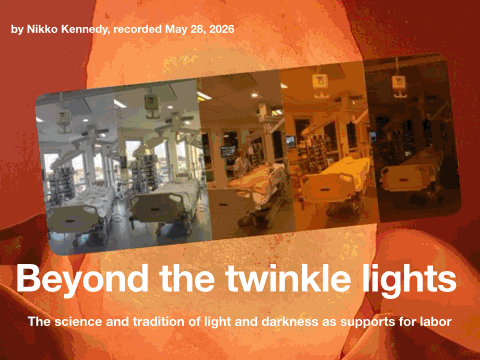
Trials have long since proven that women laboring in a dim room have more contractions and higher melatonin than women laboring in a bright room.
Dim light for the laboring woman is an obvious ancient and intuitive practice, but because of modern lighting technology, we now have to use science to explain it and demand it back.
When 41% of women cite pain or fear of pain as their reason for choosing c-section, and c-section rates rising higher and higher, something as simple as adopting circadian rhythm friendly lighting is such low hanging fruit.
We ought to be seeing circadian lighting and awareness roll out for birthing women much faster than it is.
If you want to learn to speak the science that changes doctor’s minds on this, I’m your doula.
Their real, biggest concern? Not being able to asses baby’s skin color after birth, which is easily fixed at minimal disruption to mother-baby’s rhythms by using incandescent light instead of LED.
The most recent class in the community membership is all about the science and practice of light in labor and the immediate postpartum:
https://www.brighterdaysdarkernights.com/p/how-to-use-light-and-darkness-in